Cast your mind back to 1996… the Web’s shiny and new, and we’re trying to figure out what this means for scholarly publishing in EdTech…
The Web is a 3 year old toddler, we’ve just figured out how to embed multimedia in Mosaic and Netscape browsers (hello Apple QuickTime, MacroMind Shockwave, Java applets…), Paul Ginsparg’s 5 years into something he calls arXiv, Stevan Harnad‘s championing open access journals and piloting “scholarly skywriting”, and the threaded discussions of the wildly successful Usenet newsgroups have made it into Perl-based web interfaces like Daniel LaLiberte‘s HyperNews.
It’s 1996, and Diana Laurillard has just invited Tammy Sumner and CIC’s Simon Buckingham Shum to serve as inaugural editors of a new journal she’s conceiving, called JIME: The Journal of Interactive Media in Education. As she now recalls in the 30th Anniversary Guest Editorial, just out:
“The interactive digital experiences we were creating for learners were so exciting, so different from the teacher-controlled sequence of explanations with multiple choice tests that abounded then, and still do. The point of using digital media was that the students could interact with a model of something, explore it, find out what it could do, use it to test their own thinking – the design was to be learner-led.
So the big idea for a new journal was to be wholly online, so that you could link in an interactive simulation or demonstration of your wonderful new interactive medium, to enable people to experience your ground-breaking creation.”
Tammy and Simon had just joined The Open University‘s new Knowledge Media Institute, so we saw an action research opportunity:
“What would happen if we fused all these new affordances, and stretched things further? Interactive multimedia embedded in the article, all within the web browser, plus open access publishing, plus (inspired by computer-supported discourse) review discussions, continuing with open commentaries after publication? Interactive not only with regard to the multimedia, but the scholarly discourse.”
Many thanks to JIME’s current editors Robert Farrow & Katy Jordan for conceiving this celebration editorial by all of JIME’s editors from the last 30 years who have stewarded it through those rapids. Quite a case study in Open Access scholarly publishing!
Enjoy their reflections 😀
Laurillard, D., Buckingham Shum, S., Sumner, T., Scanlon, E., McAndrew, P., Jones, A. and Weller, M. (2026). 30th Anniversary Guest Editorial: Reflections from JIME Editors. Journal of Interactive Media in Education, 2026(1): 15, pp.1-12. https://doi.org/10.5334/jime.1163
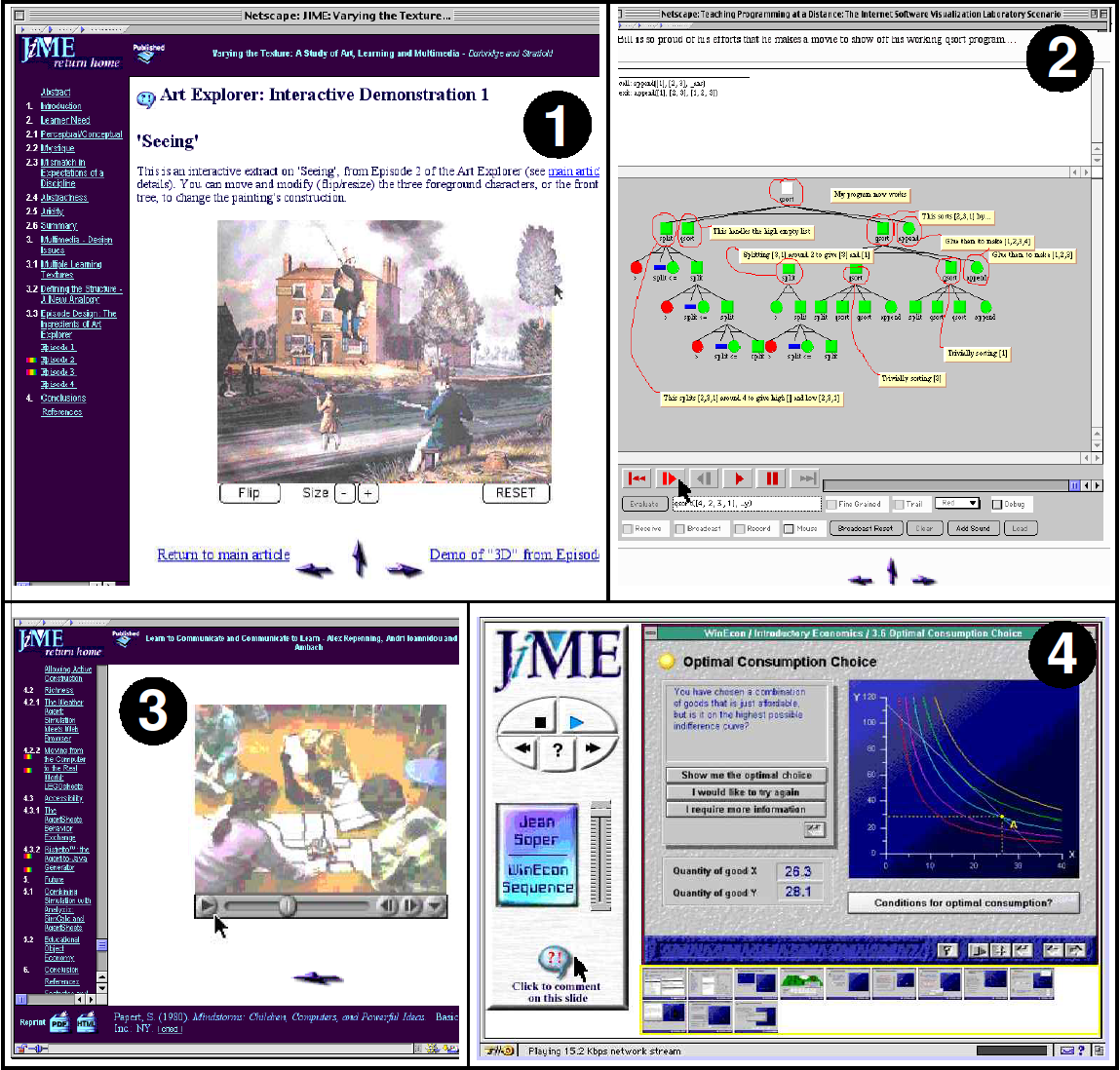
Figure 1: Interactive multimedia embedded in JIME articles rendered in a web browser. (1) Interactive extract from an art history CD-ROM that enables readers to play with the construction of a painting (Durbridge & Stratfold, 1996); (2) interactive Java applet for visualizing code execution over the internet (Domingue & Mulholland, 1997); (3) extract of video showing children programming a robot (Repenning, et al. 1998); (4) introductory walkthrough of an economics package with commentary from the author (Soper, 1997).
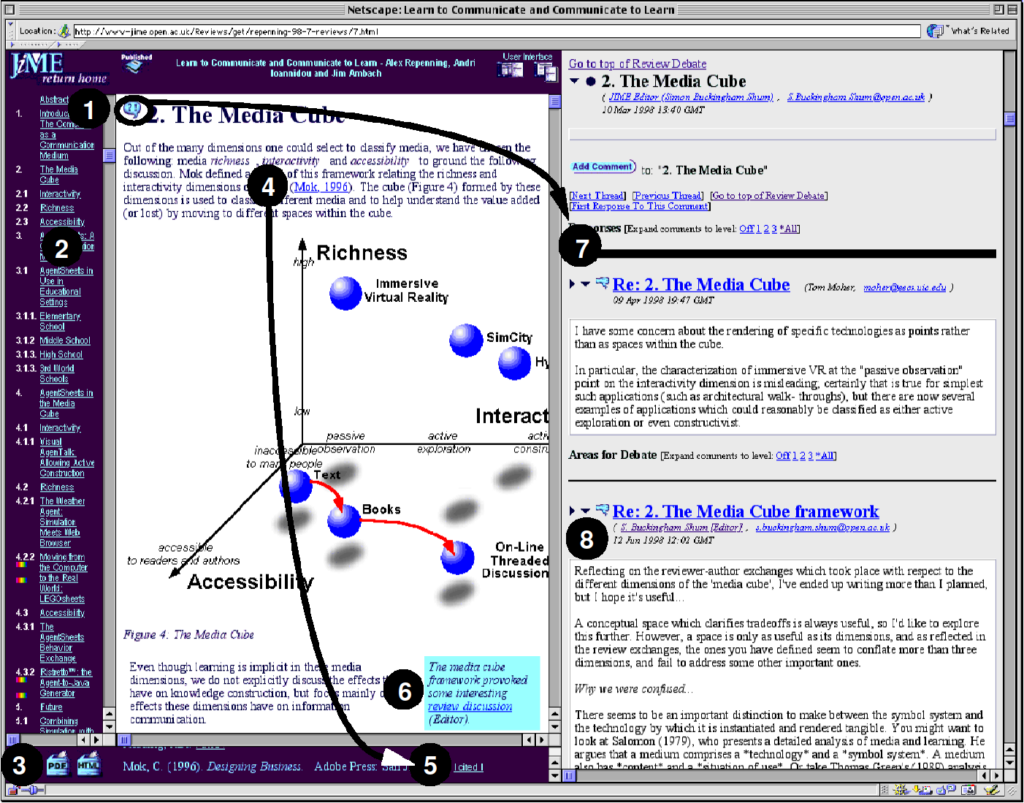
Figure 2: JIME’s document interface. On the left is the Article Window, on the right the Commentaries Window showing the top-level outline view of discussion about the document. Key: (1) Comment icon embedded in each section heading linking to section-specific comments; (2) active contents list extracted from the section headings; (3) print versions as HTML and PDF; (4) numeric or author/date citation automatically linked to corresponding reference in footnote window; (5) a reverse hyperlink is inserted for each citation of a reference; (6) an editorial note to draw attention to a controversial issue in the author–reviewer debate that ‘made it’ into the published version; (7) section-specific review comment; (8) an editorial comment summarizing the review discussion and specifying change requirements. (Note that there are two versions of the user interface: one as shown, and for smaller displays, the document and discussion are placed in separate browser windows.)
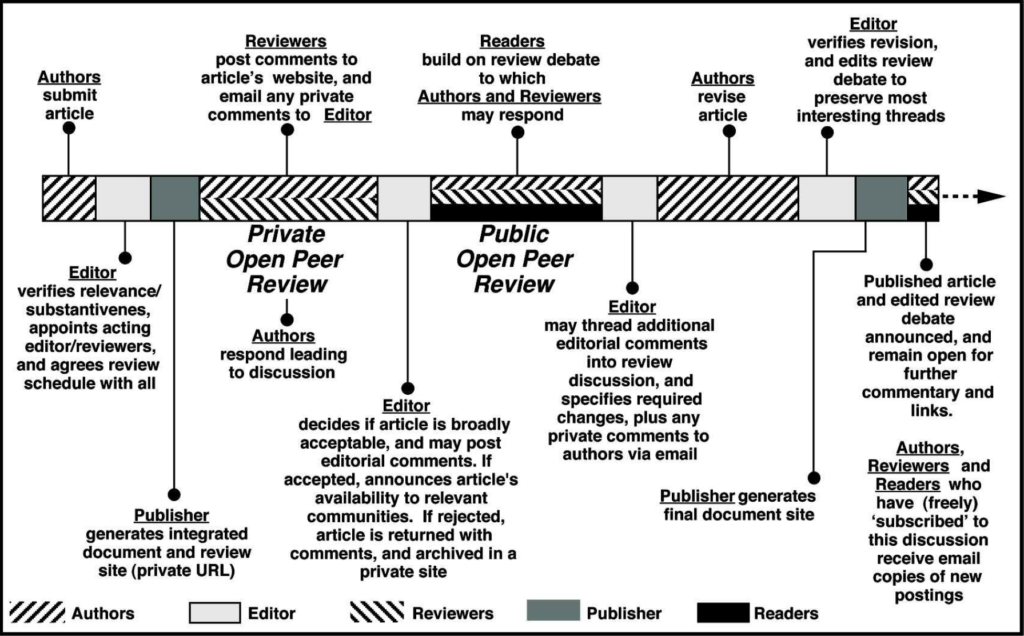
Figure 3: The JIME discourse-centric review process. This cycle includes private and public open peer-review phases, with active stakeholders involved at different points.